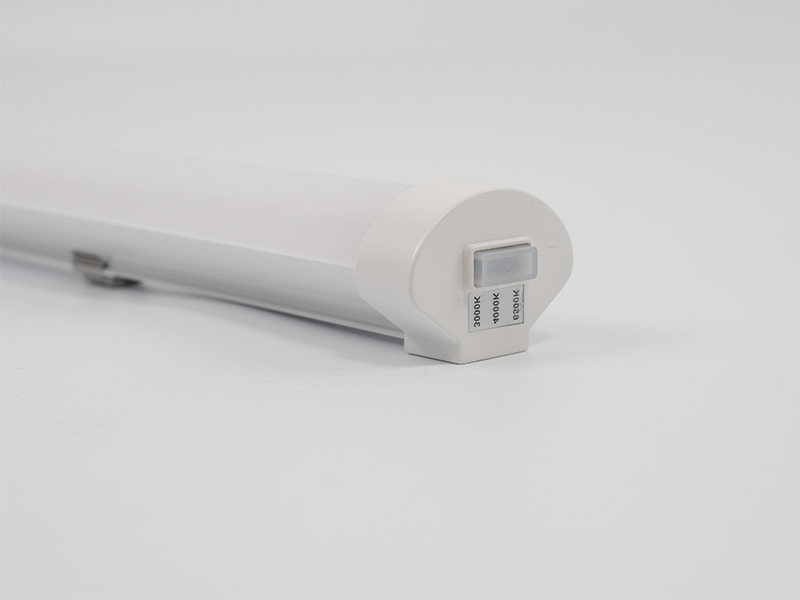


Can an IP65 LED Tri-Proof Light Fixture Be Used in a Parking Lot?
Can an IP65 LED Tri-Proof Light Fixture Be Used in a Parking Lot?
Short answer: yes. An IP65 LED tri-proof light is not only “usable” in a parking lot—it is one of the most common and practical choices for parking garages, covered lots, canopies, loading areas, and many open-air parking zones. The real question is not whether it can be used, but where and how it should be specified.
Below, we’ll break down what IP65 actually means, what “tri-proof” protects against, where tri-proof lights work best in parking facilities, where you may need a higher rating, and how to design a parking lot lighting system that is safe, energy-efficient, and low-maintenance.
1. What Does IP65 Really Mean?
IP stands for Ingress Protection, defined under IEC 60529.
First digit “6”: the fixture is fully protected against dust. Fine particles cannot enter the enclosure in amounts that would harm the electronics.
Second digit “5”: the fixture is protected against low-pressure water jets from any direction.
So an IP65 LED tri-proof light can handle:
Rain under a canopy
Splashes from cleaning
Humidity and condensation
Dust from vehicles and nearby roads
Occasional water from mopping, hose cleaning, or pipe leaks
What IP65 does not guarantee:
Protection against high-pressure washdown
Temporary immersion
Direct driving rain on a fully exposed pole if the fixture or conduit seals are poor
Impact resistance by itself
That’s why IP rating and IK rating should be evaluated together.
2. What Makes a Light “Tri-Proof”?
“Tri-proof” usually means:
Waterproof / weatherproof
Dustproof
Corrosion-resistant / impact-resistant
Different manufacturers emphasize slightly different “third proofs,” but in parking lot applications the important properties are:
Sealed polycarbonate or polycarbonate + aluminum housing
Gasketed diffuser
Stainless-steel or corrosion-resistant clips
Sealed cable glands
Anti-yellowing UV-stabilized cover
Resistance to vehicle exhaust, humidity, and cleaning chemicals
Because parking lots combine moisture, dirt, vibration, and occasional physical knocks, tri-proof fixtures are far more suitable than open LED battens or standard office-style linear lights.
3. Is IP65 LED tri-proof light Enough for a Parking Lot?
In most cases, yes.
Parking facilities are rarely completely dry and clean. They are often:
Humid
Dusty
Oily
Exposed to vehicle emissions
Subject to leaks from pipes or ceilings
Cleaned periodically with water or detergent
An IP65 tri-proof fixture handles these conditions well.
A. Underground Parking Garages
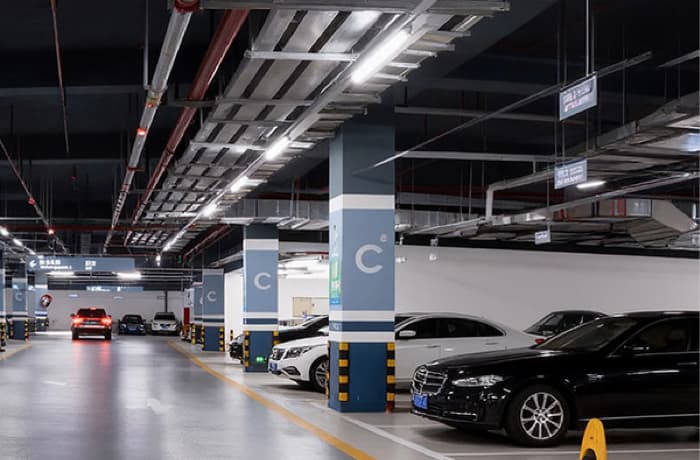
Underground structures are damp by nature. Condensation, concrete moisture, and poor ventilation make ordinary fixtures fail early. IP65 LED tri-proof lights are widely used here because they resist humidity and dust while providing uniform aisle lighting.
B. Covered Parking Decks
Covered decks get wind-driven rain, bird droppings, leaves, and cleaning water. IP65 is usually sufficient if the fixture is properly installed with waterproof connectors.
C. Canopies and Entrance Areas
Gas-station-style canopies, building drop-off zones, and residential building podium parking often use IP65 linear tri-proof luminaires.
D. Open-Air Parking Lots
Here the answer becomes more nuanced. IP65 can work for:
Surface-mounted lights under structures
Perimeter building lighting
Walkway lighting
Stair towers
Ramps with partial coverage
But for fully exposed poles facing heavy rain, snow, pressure washing, or direct weather from all sides, many designers prefer IP66, and in washdown or flood-prone zones, IP67.
4. IP65 vs IP66 vs IP67 for Parking Lots
IP65 – Low-pressure jets, rain splash, humidity – Best for garages, canopies, covered decks, stairwells
IP66 – Strong water jets – Best for car washes adjacent to lots, pressure-washed ramps
IP67 – Temporary immersion – Best for flood-prone basements, drainage zones
For a typical commercial or residential parking structure, IP65 is the minimum professional baseline. For harsh outdoor sites, IP66 is safer. IP67 is usually overkill unless immersion is possible.
5. Don’t Forget IK Rating: Parking Lots Get Hit
A parking lot is not a quiet office ceiling. Drivers misjudge clearance. Carts, mirrors, pallets, cleaning equipment, and service vehicles can strike fixtures.
That’s why IK rating matters:
IK08: resists about 5 joules of impact—good for general corridors.
IK10: resists 20 joules—better for parking garages, columns near drive aisles, low ceilings, and fork-lift or cart traffic.
A good parking lot LED tri-proof light is often specified as IP65 + IK08 minimum, and IP65/IP66 + IK10 for higher-risk zones.
6. Light Quality Matters More Than People Expect
Just being “waterproof” does not make a fixture good for parking.
Parking lot lighting must:
Reduce shadows
Help drivers read lane markings
Help pedestrians see trip hazards
Improve camera footage
Reduce fear of crime
Avoid excessive glare
Good tri-proof parking fixtures typically offer:
4000K–5000K color temperature
110–140 lm/W system efficacy
CRI 80+
Uniform diffusion through a milky PC lens
Low UGR for comfortable visibility
Type III or Type V optical distribution depending on layout
For parking, 4000K often looks more natural and less harsh than 6500K. 5000K is popular for commercial garages because it feels “daylight bright” and improves surveillance clarity.
7. Energy Savings and Controls
One big reason IP65 LED tri-proof lights are used in parking lots is operating cost.
Compared with fluorescent or HID lighting, LED tri-proof fixtures:
Use far less energy
Last 50,000+ hours
Reduce relamping labor
Generate less heat
Work well with controls
Smart parking lot features include:
Microwave or PIR motion sensors: dim to 20–30% when empty, ramp to 100% on movement.
Daylight sensors: reduce output when ambient light is sufficient.
0–10V or DALI dimming: integrate with building management systems.
Emergency battery packs: LiFePO4 backups provide 90–180 minutes of light during power failure.
In a 24/7 parking structure, sensor-based dimming can cut energy use dramatically while keeping safety high.
8. Installation Considerations
An IP65 fixture can still fail if installed poorly. For parking lots, pay attention to:
A. Cable Entry
Use proper IP-rated cable glands or conduit fittings. A waterproof fixture is only as good as its worst seal.
B. Mounting Height
Tri-proof linear lights are common at:
2.5–4 m for low garage ceilings
4–6 m for open decks
Higher outputs or supplementary flood/pole lights for large open lots
If the ceiling is very high, a tri-proof batten alone may not give enough punch. You may need high-bay or shoebox/pole-mounted area lights for the main driving lanes.
C. Thermal Management
Sealed fixtures trap heat. In hot climates or poorly ventilated garages, choose a quality driver and possibly an aluminum-frame hybrid housing. A cheap driver in a sealed PC tube will shorten lifespan.
D. UV Resistance
Outdoor-facing diffusers should be UV-stabilized to avoid yellowing and brittleness.
9. When IP65 Tri-Proof Is the Right Choice
Choose IP65 LED tri-proof lights when:
The space is covered, semi-covered, or sheltered
Humidity and dust are present
You need linear, uniform light along aisles
Ceilings are low to medium height
Maintenance access is difficult
You want long life with low labor cost
You need corrosion resistance from vehicle exhaust and cleaning chemicals
This makes them ideal for:
Underground parking garages
Residential podium parking
Retail center covered lots
Hospital and office garage decks
Warehouse loading zones
Factory yard parking
Stairwells and pedestrian ramps
10. When You Should Upgrade Beyond IP65
Consider IP66 or a more rugged luminaire if:
The fixture is fully exposed to driving rain
It will be pressure-washed regularly
It is near a car wash or fuel station wash bay
Snow and ice buildup is common
The site has flooding history
The fixture is mounted where vehicles repeatedly hit it
Also consider dedicated parking lot area lights or shoebox fixtures for large open lots. Tri-proof lights are excellent for structured parking, aisles, and ceilings—but a big open asphalt lot often needs pole-mounted directional optics for proper spacing and uniformity.
11. Example Specification for a Parking Garage
A practical IP65 LED tri-proof light specification might look like this:
IP65 ingress protection
IK08–IK10 impact resistance
1200 mm or 1500 mm linear body
36–65 W depending on ceiling height
4000K or 5000K
120–140 lm/W system efficacy
CRI ≥ 80
PC housing, UV-stabilized diffuser
Stainless or corrosion-resistant clips
0–10V dimming or microwave sensor optional
LiFePO4 emergency pack optional
50,000-hour L70/B10 design life
Compliance with IEC 60598 / relevant regional safety standards
That configuration is reliable, safe, and cost-effective for most parking structures.
Final Verdict
Can an IP65 LED tri-proof light fixture be used in a parking lot? Absolutely.
It is one of the best options for garages, covered decks, canopies, ramps, and pedestrian areas. It resists dust, moisture, corrosion, and everyday abuse far better than standard linear fixtures.
But “IP65” alone is not the whole story. For a safe and professional parking lot, also check:
IK rating
Optic and beam spread
Color temperature
Lumen output
Driver quality
UV resistance
Installation method
Whether the space needs pole-mounted area lights in addition to tri-proof linear fixtures
If the area is sheltered or semi-outdoor, IP65 tri-proof is often the sweet spot. If it is fully exposed or washdown-heavy, move to IP66. If immersion is possible, consider IP67.
Done right, IP65 LED tri-proof lights give parking lot owners exactly what they want: bright, uniform light, fewer failures, lower energy bills, and minimal maintenance.